
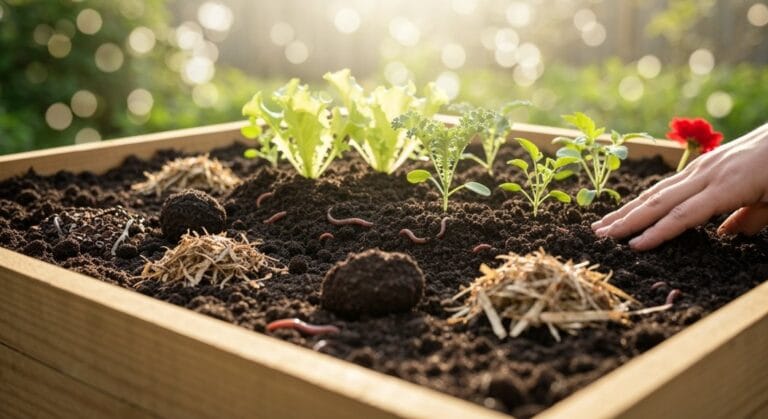

The Best Soil Mix for Raised Beds: Your Recipe for Root Zen
If you’ve committed to raised bed gardening, you’ve already made a fantastic choice. They warm up faster, offer superior control over your growing environment, and let’s be honest, they look great.
But here’s the crucial part: the soil is everything. Unlike native ground gardening, you’re building a complete ecosystem from scratch, which is why finding the best soil mix for raised beds is so important. It’s not just dirt; it’s the foundation for amazing yields.
We’re going to walk through the ideal raised bed soil recipe—the ratios that keep things perfectly fluffy, moist, and fed—so you can stop guessing and start growing!
- Key Takeaway #1: Aim for a loamy mix: roughly 50% topsoil, 30–40% organic matter, and the rest mineral particles for stability.
- Key Takeaway #2: Compost volume should land between 25–30% for ideal moisture retention and microbial life.
- Key Takeaway #3: Proper drainage relies on coarse particles like sand or perlite to ensure roots can breathe.
- Key Takeaway #4: Plan to replenish about 1–2 inches of compost on top every year, as organic matter breaks down.
- Key Takeaway #5: Use targeted watering methods like drip irrigation to maintain consistent moisture levels.
Essential Soil Components for Raised Beds
When we talk about great soil, we’re essentially aiming for that mythical “loamy” texture—the stuff that feels wonderful in your hands and drains perfectly. To achieve this in a raised structure, you need three main categories of ingredients working together.
First, you need the structure: about 50% premium, stone-free loamy topsoil. This is your mineral base—the sand, silt, and clay particles that provide heft and stability so your bed doesn’t instantly turn into mush. If you’re filling large beds, buying topsoil in bulk is usually the most economical route.
The second part is the powerhouse: organic matter. Your goal is to include about 30% high-quality compost. Compost feeds the soil life, acts like a sponge to hold moisture, and slowly feeds your plants over time. If you can source vermicompost (worm castings), even better, as it’s packed with nutrients.
Finally, you need elements focused purely on structure and drainage. This is often 10–20% of the mix, containing coarse materials like horticultural sand or perlite. These particles create tiny air pockets (porosity) that let excess water escape and allow your plant roots to breathe easily.
Interestingly, while we don’t want pure clay in our mix, a small percentage (usually naturally present in topsoil) is necessary because it helps hold onto some essential nutrients. We just don’t want it to be the dominant ingredient!
Balancing Organic Matter and Mineral Soil: What Percentage Compost Should I Use in Raised Beds?
Getting the ideal organic matter volume in raised beds correct is the secret sauce. Many beginners add too much compost, which can actually cause nutrient imbalances or make the soil too light and fluffy to stand up to heavy crops.
A great starting point for the best raised bed soil mix is approximately 40% mineral soil (topsoil), 40% compost, and the remaining 20% dedicated to drainage aids (sand/perlite). This ratio really captures that fertile, sweet spot.
| Feeling | Fact | Promise |
|---|---|---|
| Hopeful | 40% organic optimizes retention | Plants thrive |
| Grounded | Minerals prevent compaction | Less upkeep |
| Caring | Microbes cycle nutrients | Healthier crops |
| Responsible | Replace decomposed OM yearly | Lasting beds |
Remember, that beautiful organic matter will decompose. If you started with 40% compost and didn’t add any more, by year three, you might only have 25% left. That’s why yearly top-dressing is so important!
When buying soil, look for products that are OMRI-listed if you’re committed to organic methods. Some popular commercial options use composted green waste, which is a great peat-free compost substitute that supports soil structure.
Improving Drainage and Soil Structure
If you live in an area with heavy, existing soil, you might worry about how to improve raised bed drainage. Waterlogged soil equals suffocated roots, which is a major production killer.
This is where coarse amendments shine. Sand, coarse perlite, rice hulls, or well-aged wood chips are your friends. They create space within your loamy soil composition, allowing gravity to pull excess water down and away.
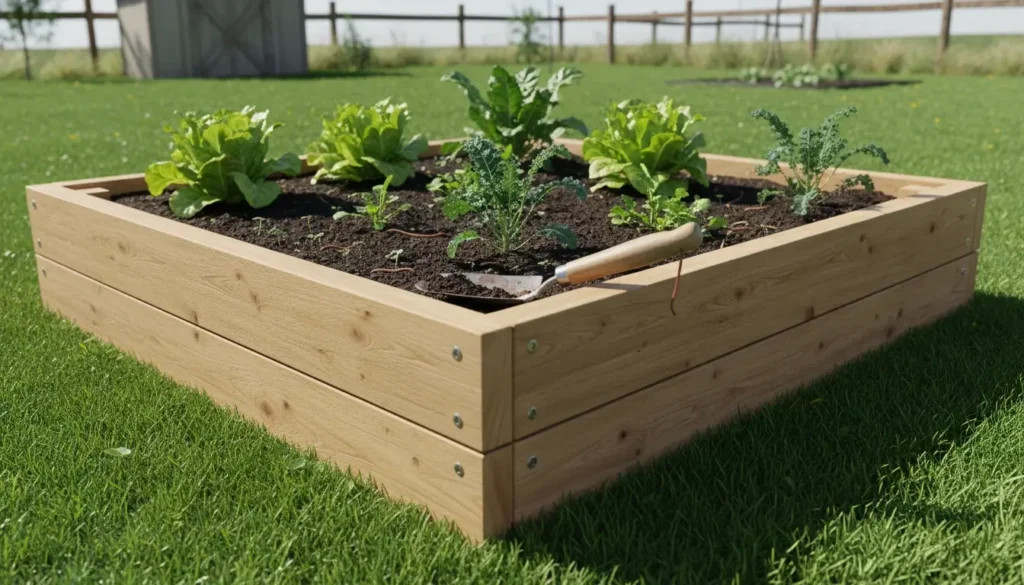
If you are starting with heavy native soil, you might wonder how to amend native soil for raised bed gardening if you decide to bring some in. In that case, aim for at least 50% clean topsoil and heap in the compost and grit. Avoid using pure clay soil as your bulk material; it will compact too easily.
A great trick for deep beds is layering. You can place coarse woody material or chips at the very bottom layer. As these slowly break down over years, they improve long-term aeration and reduce the necessity for huge amounts of expensive finished compost right at the start.
Practical Amendments and Mixing Ratios
Let’s talk recipes. The goal here is to solidify your mixing ratios for raised beds based on texture feel. If your soil feels gritty and drains instantly (sandy), you need more compost and possibly a tiny bit of finely sifted clay/silt to boost retention.
If it feels dense and squishes together (heavy clay), you need to aggressively increase your coarse material. A good rule when dealing with significant clay in your native soil component is a ratio of roughly 3 parts native soil to 1 part amendments (compost + sand/perlite).
For a premium starting blend, try these benchmarks for mixing ratios for raised beds:
- 50% High Organic Matter Topsoil (ensuring good mineral balance)
- 25% High-Quality Aged Compost
- 25% Aeration (coarse sand, perlite, aged bark fines)
If you only have access to bags of different ingredients, remember the 30–40% organic matter sweet spot. Don’t let your blend stray too far above 50% OM, or you might struggle with nutrient instability!
| Empathy | Action |
|---|---|
| Feed neighbors | Share extras |
| Teach kids | Let them mix |
| Nourish soil | Test texture |
| Steward land | Use quality compost |
Maintenance: Watering, Replenishing, and Soil Health
Once you’ve built the perfect environment, maintenance is about consistency, not hard labor. Because raised beds are inherently well-drained, they dry out much faster than an in-ground garden, especially during summer heatwaves.
We rely on deep, efficient watering. Forget the fleeting midday sprinkler spray. You want to water deeply but less frequently, aiming for about 1 to 2 inches of water soaking into the soil profile per week, total.
Raised beds dry fast—water deeply and close to the soil (drip, soaker, or ollas) for 1–2″ weekly.
Drip irrigation maintenance is key here. Soaker hoses or drip emitters deliver water precisely to the root zone, keeping foliage dry (which prevents disease) and minimizing evaporation loss. Ollas (buried clay pots you fill with water) are also fantastic low-tech options.
The other maintenance task is replenishment. As microbes feast on your beautiful compost, it sinks. You need to replace that volume. Plan to top-dress your beds with a fresh inch or two of compost every spring or fall to maintain that ideal structure and nutrient turnover.
Also, please, try not to step in your beds! Whether you use wooden boards to walk across or just stick to the edges, compaction crushes those vital air pockets you worked so hard to create. This preserves soil aeration for years.
Frequently Asked Questions
Can I Use Native Clay Soil Without Adding Any Amendments?
If you rely only on native clay soil without adding amendments, your results will likely be disappointing. Clay compacts heavily, restricts root growth, and drains poorly. For raised beds, you mostly want the mineral base from topsoil, but you must lighten it significantly with compost and coarse drainage material.
How Deep Should a Raised Bed Be for Root Vegetables?
To give roots like carrots, parsnips, or potatoes the space they need to grow straight and large, aim for a growing depth of at least 12 to 18 inches of fluffy, amendable soil. This is crucial for ensuring easy harvesting later on.
Is It Safe to Plant Edibles in Raised Beds Over Contaminated Ground?
Generally, yes, raised beds are safer than planting directly into potentially contaminated native ground. However, you must ensure a sufficient barrier (like heavy plastic sheeting or landscape fabric) if contamination is a concern, and you should always fill the bed entirely with tested, clean soil.
Can I Use Store-Bought Potting Soil Instead of a Soil-Compost Mix?
You can, but be cautious. Many bagged potting soils are designed for containers—they are very light and often break down too quickly in deeper beds. If you use potting soil, mix it 50/50 with bulk topsoil and add extra compost to achieve the density and lasting structure required for raised beds.
How Often Should I Test My Raised Bed Soil for Nutrients and pH?
For a well-established raised system, testing the crucial metrics like pH and major nutrients every 2 to 3 years is usually sufficient. If you notice plants struggling or see unusual leaf discoloration, perform a spot check sooner than planned.


