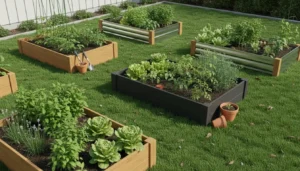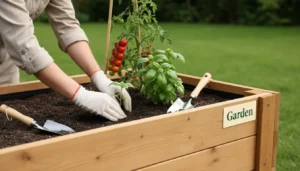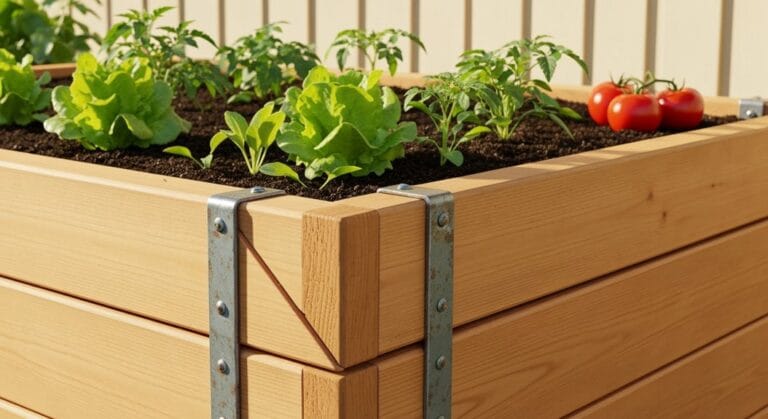

I’ll never forget the day I walked out to my garden and found my pride and joy—a beautifully constructed 4’x12’ raised bed—had turned into a subtle smile. The long sides were bowing outward like a barrel, and I could see the wood fibers starting to separate right at the corners. My tomatoes looked genuinely concerned!
I’d made the classic mistake: I built it with standard 2×6 boards, filled it to the brim with rich, heavy soil, and assumed good intentions would hold the whole structure together. Spoiler alert: intentions don’t stop physics.
That moment taught me something crucial that often gets glossed over: soil is heavy. That weight creates tremendous outward pressure on your walls. We’re talking about hundreds of pounds pushing against relatively thin wood from the inside. If you’re wrestling with raised bed walls bowing, you’re not alone; this is the number one structural failure gardeners face.
The good news? This is completely preventable. After years of fixing and rebuilding, I’ve learned exactly what separates a rock-solid raised bed from one that slowly deforms into a garden relic. Let’s walk through exactly how to prevent raised bed bowing for good.
Key Takeaways for Structural Stability
- Material matters: Always choose cedar, redwood, or composite lumber over standard pine for long-term results.
- Thickness is non-negotiable: Use 2×8 boards for any bed 4–6 feet wide; thicker for larger spans.
- Bracing prevents bowing: Corner braces and mid-span supports are essential for distributing soil pressure.
- Screws beat nails: Always secure joints with 3–4 inch exterior screws, using at least four per corner.
- Don’t overfill: Leave 2–3 inches of space below the rim to reduce total weight and outward force.
- Drainage reduces stress: Drier soil weighs less, lessening the hydrostatic pressure on the walls.
- Inspect annually: Tighten loose fasteners and replace rotted lumber before failure occurs.
Why Do Raised Beds Bow Out? Understanding Soil Pressure
Before we can fix this, we need to respect the enemy: outward pressure soil. When you fill a bed with rich, moist garden mix, you create significant hydrostatic pressure garden conditions. A cubic foot of moist soil weighs roughly 100 pounds.
If you have a 4’x12’ bed that’s two feet deep, you have 96 cubic feet of soil inside. That means about 9,600 pounds of total weight is pressing down and outward. That force doesn’t just disappear; it pushes against the weakest point.
If that total weight is distributed across the two long sides, each wall is supporting about 4,800 pounds of outward push. If your walls aren’t engineered to handle that continuous load, they will eventually yield. It’s pure physics, not a sign you’re a bad gardener.
The bowing starts small—maybe you don’t notice it for a year or two. But under constant stress, the wood fibers yield, the corners separate, and suddenly your perfectly square frame looks like a collapsing fortress.
Material Selection: Your First Line of Defense Against Bowing
The longevity of your frame starts with what you choose to build it from. This is your initial investment in structural integrity.
Wood Type Matters More Than You Think
Standard pine and spruce—the cheap stuff—are softwood. They’re easy on the wallet, but they compress under sustained load. If you use standard lumber for a deep bed, expect visible deformation within three to five years.
For long-term stability, you need denser, naturally rot-resistant options. Cedar and redwood are significantly stiffer. They resist the soil pressure much better than pine.
If the budget allows, look into composite lumber. It won’t rot, and it has far greater resistance to bowing than wood. The trade-off is the higher upfront cost.
For me, cedar remains the sweet spot—durable, reasonably priced, and it looks fantastic in the yard.
The No-Compromise Option: Metal Frames
If you want absolute assurance that your structure won’t bow, metal is the way to go. Galvanized steel or aluminum frames are almost entirely immune. They are stronger per pound than wood and will last indefinitely if sized correctly.
The drawback is material cost and heat; metal beds can heat up significantly in direct sun, which you must manage with heavy mulching.
Wall Thickness: The Game-Changing Detail for Stability
This is where most people fail when trying to prevent raised bed bowing. They assume the stated dimensions mean they have sufficient thickness to resist load. They’re usually wrong.
A nominal 2×6 board is actually only 1.5 inches thick. Under the massive, sustained pressure we discussed, 1.5 inches eventually gives way. This is why knowing the what size wood to use for raised bed sides is critical.
The Thickness Benchmark Guide
Thicker boards resist bending much better than thin ones because stiffness increases dramatically with depth.
For a bed up to 4 feet wide, a 2×6 might be the bare minimum, provided the wood is high quality. For anything between 4 and 6 feet wide, step up immediately to a 2×8.
If you are building very long beds or going over 18 inches deep, you should strongly consider a 2×10 or doubling up the lumber.
| Bed Width | Recommended Board Thickness | Why This Works | Expected Lifespan (Pine vs. Cedar) |
|---|---|---|---|
| Up to 3 feet | 2×6 (1.5″ actual) | Minimal soil pressure | 5–8 years (Pine), 10–15 years (Cedar) |
| 3–4 feet | 2×6 (1.5″ actual) | Moderate pressure, manageable | 5–10 years (Pine), 12–18 years (Cedar) |
| 4–6 feet | 2×8 (1.75″ actual) | Higher pressure demands more girth | 8–12 years (Pine), 15–25 years (Cedar) |
| 6+ feet | 2×10 (2.25″ actual) or doubled 2x8s | Significant pressure requires serious dimension | 10–15 years (Pine), 20+ years (Cedar) |
The doubling strategy—screwing two 2x6s together to mimic a thicker dimension—is a good way to add strength while achieving a layered aesthetic if you don’t want the depth of a 2×10.
Bracing and Cross-Support Systems: How to Stop 4×12 Raised Beds From Bowing
Even with thick boards, you need internal or external bracing to handle the pressure. Bracing is the skeleton that distributes stress and fights inward collapse.
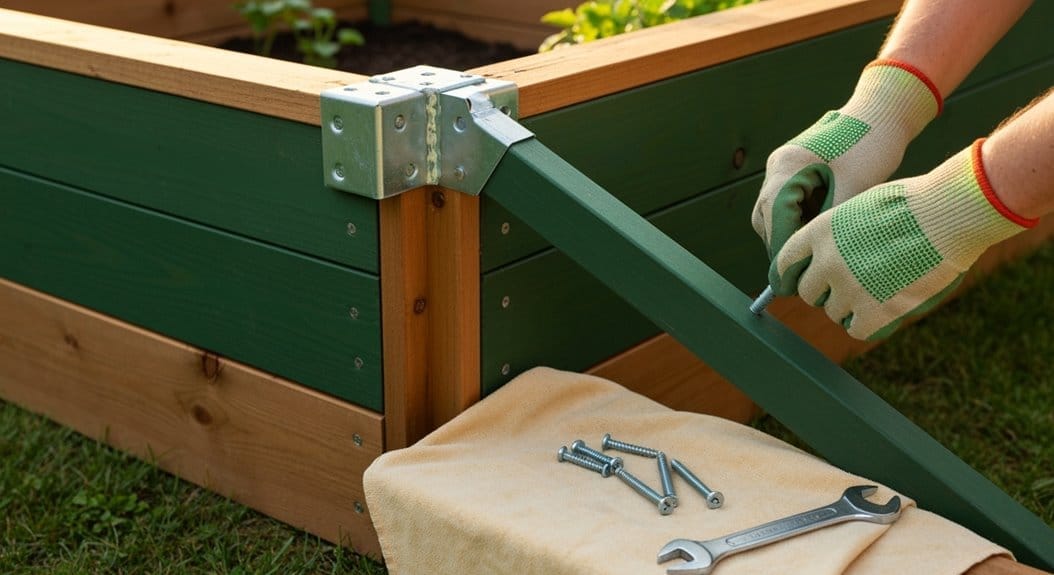
Corner Braces Are Load-Bearing Necessities
The corners are the critical failure points. The wood fibers are pulled apart at a sharp angle, and without support, the frame separates easily.
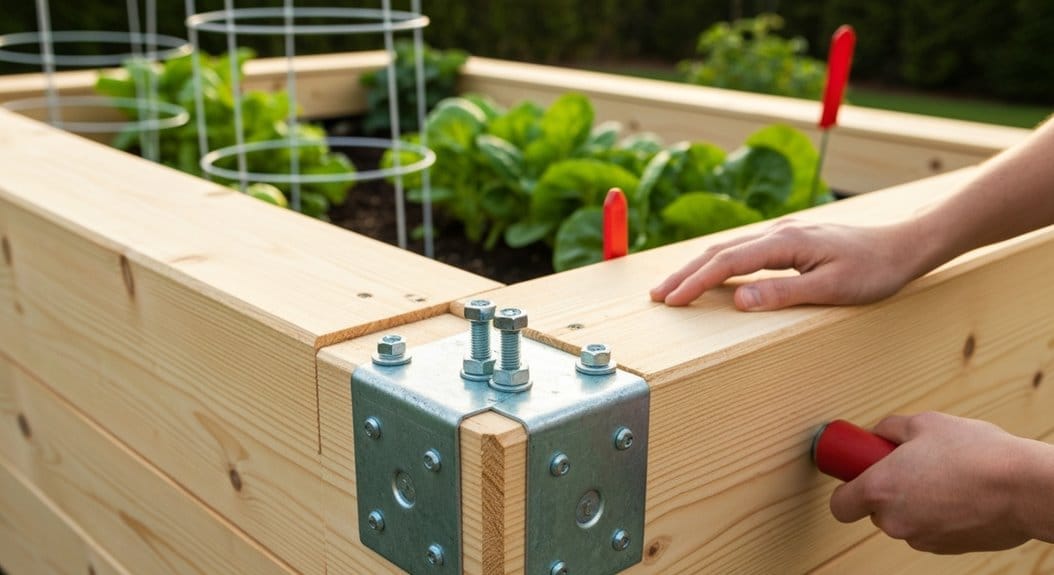
I highly recommend strong metal L-brackets for all four corners, screwed securely into both joining boards. This simple addition significantly enhances the life of your structure.
If you prefer wood reinforcement, cut 2×4 sections at 45-degree angles. Placing these diagonally inside the corners creates a rigid triangle, which is the strongest shape under load.
Best Bracing for Long Raised Beds (Mid-Span Support)
If your bed is longer than 6 feet, corner braces alone aren’t enough. You need best bracing for long raised beds to address the long spans. I place vertical supports or cross-braces every 3 to 4 feet along the exterior or interior of the long sides.
This breaks up the unsupported distance, distributing the soil pressure across more anchor points. Think of it like supporting a long table with extra legs; the strain on any single point is dramatically reduced.
The Exterior Post Method for Tall Beds
For how to stop 4×12 raised bed from bowing when they are deep (18 inches or more), consider external vertical posts. Attach 2×4 uprights firmly to the outside of the bed frame at intervals. If these posts extend a foot or more beyond the frame base and are anchored against the ground, they essentially tether your wall to the earth, making lateral movement very difficult.
Joint Reinforcement: Where Wood Meets Wood
How you fasten the material together is just as important as the material itself when preventing structural collapse.
Screws vs. Nails: A Clear Winner for Longevity
Nails are fast, but they are notorious for loosening under the constant shift and settling that occurs in a damp environment. Screws, however, maintain tension because of their spiral threads, holding the joint tight even as the wood breathes.
For raised garden bed reinforcement, use exterior-grade wood screws, ideally 3 to 4 inches long. Pre-drill your holes to prevent splitting the wood, and drive at least four screws through the long board and into the end grain of the short board at every corner.
Bolts for Maximum Security
If you’re building an extra-large or very tall structure, consider drilling all the way through the boards at the corners and securing them with through-bolts, washers, and lock nuts. This creates a true mechanical lock in the joint that simply cannot loosen from soil pressure.
Managing Soil Pressure: The Weight Question
Even the most robustly built frame will eventually succumb if you overload it with heavy, saturated fill.
Don’t Overfill Your Bed
Always leave 2 to 3 inches of clearance at the top rim. This might sound negligible, but it drastically reduces the total weight bearing down on your walls. It also gives you space to apply mulch later, which conserves water.
By not filling those final few inches, you are actively reducing the outward force your walls must resist.
Use Lighter Soil Mixes
If you are rebuilding an older bed that always bows, lighten your soil composition. Pure topsoil compacts heavily and holds too much water. Try a mixture using more compost and porous material like perlite or coarse sand.
A lighter mix reduces the overall load, which directly lessens the strain on the wood. This is a great strategy when trying to figure out best wood for raised beds to prevent bowing—sometimes the solution isn’t just stronger wood, but lighter dirt!
Drainage and Water Pressure: The Overlooked Factor
We already know waterlogged soil is heavy soil. Wet soil exerts significantly more outward pressure than a healthy, airy soil profile. Therefore, good drainage is an essential passive bracing strategy.
Ensure your structure isn’t sitting in a puddle. Grade the area around the bed so runoff flows away. Inside, make sure your soil mix contains materials—like coarse sand or wood chips in the bottom layer—that promote quick drainage away from the wood walls.
Long-Term Maintenance: Keeping Your Frame Upright
A good structure needs good care. A quick annual check-up will save you headaches later.
Annual Inspections and Tightening
Once a year, walk around your frame before the spring planting rush. Look closely at all the corners and joints. If you feel any wobble or see an emerging gap, tighten those screws immediately. It takes five minutes and can prevent a major failure.
Repairing Minor Bowing
If you catch a minor bow (less than an inch or so), you can often pull it back into square. Drain the soil almost completely, wrap a heavy-duty ratchet strap around the middle of the bowed side, and slowly ratchet it back toward the opposite side until it’s flush. Add or upgrade the bracing while it’s under tension, then refill the bed.
Building Your Dream Bed: A Practical Checklist
Here is my final, battle-tested checklist for building a raised bed that will last 15+ years without developing structural issues:
- Lumber Choice: Cedar or composite—resist the urge to use cheap pine for walls over 4 feet long.
- Thickness Rule: Minimum 2×8 for 4–6 foot widths; if a 2×10 isn’t an option, laminate two 2x6s.
- Corner Reinforcement: Install metal L-brackets or 45-degree wood braces on every corner.
- Span Support: For beds 6 feet or longer, add vertical posts or cross-braces every 3–4 feet along the long sides.
- Fasteners: Use only 3–4 inch exterior grade screws; use four per joint, pre-drilled.
- Fill Level: Stop filling 2–3 inches below the top rim to manage total weight.
- Drainage: Incorporate coarse material in your soil mix to prevent waterlogging and pressure buildup.
- Maintenance: Check and tighten all fasteners yearly; repair minor bows before they become major structural issues.
Frequently Asked Questions
Conclusion: Invest Now, Garden Forever
Bowing isn’t some inevitable fate awaiting every wooden raised bed—it’s a design flaw that is entirely correctable. The formula for success requires respecting the forces at work: understand the soil pressure, choose materials that can resist those forces (think thick, quality lumber), and add structural reinforcement where it matters most (corners and mid-span).
Yes, building a truly robust raised bed costs a bit more than slapping together some cheap pine boards. But that initial investment—the extra cost for cedar, the braces, and the longer screws—is what separates a bed that sags in five years from one that’s still square and productive in fifteen.
Spend the money on good engineering now and save yourself the headache of repairs later. Your future self, and even your thriving tomatoes, will thank you for building something that lasts.